Posted in Archive, May 2016

Living with Ehlers-Danlos Syndrome Type 3

I don’t talk about my EDS much, though it’s a painful condition it’s symptoms are by far less noticeable than my Dystonia. This has resulted in me being more than happy to allow it to simmer away in the background. Often people think that the condition means I’m simply just ‘a bit bendy’. The reality is slightly more complicated.

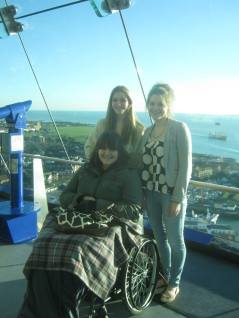
EDS Type Three affects multiple parts of the body. In my case my skin is stretchy but tears and bruises very easily, I have multiple allergies, sublux and dislocate at the slightest thing and have chronic pain. When I talk about my subluxations and dislocations people often presume that I have to have fallen over, or injured myself in some way to cause it. This is not the case; this week I woke up on Wednesday morning to discover I had dislocated my thumb in my sleep. I laughed so much at this because it is frankly a ridiculous situation to find yourself in.13184635_898295980296182_140464853_o

Whilst the EDS and Dystonia are two separate conditions they impact each other. My jaw spasms will often result in a dislocation, this happens more and more frequently. Previously the two conditions acting up at the same time would have been enough to set a seizure off. It’s a worry I have in the back of my mind frequently, there is always a chance that the next dislocation will result in me seizing in an ambulance. However, despite a recent increase in dislocations I am currently just coming up to six months’ seizure free; which has me thrilled to bits.

Posted in Archive, May 2016

Assault & Dystonia; Taking Back Control

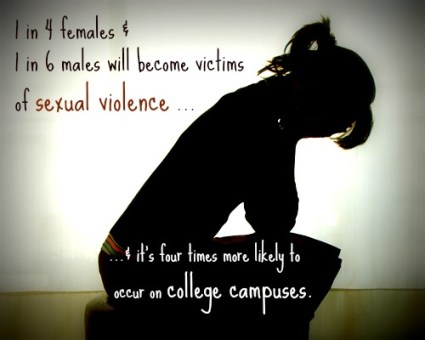
When I was diagnosed with Dystonia I developed a need for control; exercising it in life helped me cope with the lack of it in my body. Consequently, I don’t cope well when things are beyond my ability to manipulate. On the evening of the 1st May I was sexually assaulted. I’m not going to go into details. However, for a person who craves control in life this was yet another stark and frightening reminder of how little control I have. Naturally the police were involved, and I must say the support I have received from both them and my university has been outstanding. Unfortunately, due to a lack of forensic evidence the police were unable to charge my attacker. Whilst a disappointing outcome there’s a lot that can be taken from this ordeal. As many of you may have picked up from my blog posts over the last week, my emotions have been all over the place; one moment I’m smiling, the next I have a hatred for all near me, and then I’m crying. It’s been exhausting.

SA-on-College-Campus

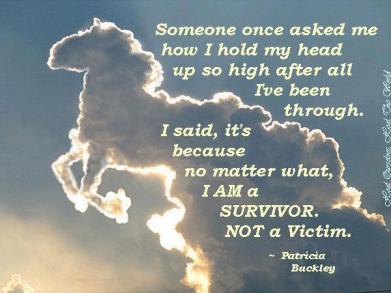
Whilst retelling the attack to the police officer working the case, he mentioned to me that many victims of assault emotionally spiral and are unable to cope; he asked that I try not to let this happen to me. I informed him that that isn’t me; I am a stubborn woman. Whilst I’ll admit the last week has been a bit up in the air, I haven’t hidden away from the world. If I can live with Dystonia, then I can make it through this. I simply refuse to let anyone have a negative impact on my life. It is mine and I will be happy!

Focusing on the positives around the incident has been key to enabling myself to feel like me again. I have been thinking about when in 2012, during a stay in hospital, a rather arrogant neurologist, who had missed the module on bedside manner, misdiagnosed my symptoms as psychosomatic. He informed my family and I that my symptoms were due to trauma and stress, and that they would continue flaring up whenever my stress levels increased. He was obviously wrong and months later I received a correct diagnosis, but this misdiagnosis and subsequent few months of incorrect treatment still irk me. However, I cannot remember the last time I was as stressed and emotionally charged as I have been over this past week, but my Dystonia has stayed at its usual spasm level throughout – despite my Botox being overdue. Proving once again that the previous neurologist was wrong. It’s a fact that for me, provides a gateway to happiness in what has been a dark time.

599395_446689295355626_50182863_n2

Posted in Archive, May 2016

Progress; Laughing Through The Pain

As Dystonia Awareness Week draws to a close it is hard not to draw comparisons to previous years. Today is my beautiful sisters 21st birthday; Happy Birthday Eloise! To celebrate we drove down to Portsmouth, where she is studying, to visit her for the day. This is something we do each year for her birthday, and it’s always a fantastic laughter filled day.

The first year we did this was 2013, my Dystonia was still very much new to me and we had not found a treatment regime that worked yet. Due to this I had sunglasses on and off all day as the sunlight was aggravating my blepharospasm, I was wearing several layers and huddled in blankets as the bite of the wind was increasing the severity of my spasms. At this time, I was completely reliant on a wheelchair. I had major trust issues when it came to people pushing me around, I was terrified they would tip me out, so you can imagine how I felt about this.

1601322_10152200842708274_1836950952_n
2013

Whereas today I got out the car and strolled to my sister’s house; if I had still been in my wheelchair I would not have been able to get through the front door! I was able to enjoy the sunshine without worrying about my eyes, and it was hot enough to not need to layer up. Even though my Botox is a week late I only had a handful of spasms over lunch, and I simply laughed through the pain. I think my mother may have doubted my sanity at this point as she asked me to recite the alphabet backwards to prove I was completely conscious.

Today has been extremely upbeat, it has shown just how far I have progressed thanks to ongoing treatment.

13073198_889059604553153_794001332_o (2).jpg
2016


Posted in Archive, May 2016

Defeat Is Fine…

This evenings blog is going to be a short one as my body is being slightly temperamental. With this in mind, I want to focus on knowing when to hold your hands up and admit defeat. Many of us are guilty of powering on through the hard times. Fixating on a task is often a very handy coping mechanism, and can be a great tool. However sometimes you can spread yourself thin and wear yourself out, causing more issues.

This last week has not been one of my best, so naturally I have kept myself busy. I have read essays for friends, thrown myself into my writing, found any and every excuse to distract myself. It has taken many conversations before I have stopped and asked for help. Now I lie here in bed, sore, spasming and stressed.

We all have moments like this when we let life get the better of us and control us. The only thing we can do is stop, breath, dust ourselves off and carry on.

Posted in Archive, May 2016

Importance of Utilizing a Support Network

Whether you are ill or not having a support system in place is something everybody needs. Everyone deals with varying difficulties in life, and whilst experiencing these a support network helps keep life ticking over and enabling you to feel like you can cope. Often during difficult times, it becomes very tempting, and easy, to simply shut yourself away from family and friends. I know personally that I would much rather deal with a problem by myself, this is simply because by talking to others the issue feels more real and daunting. However, acknowledging it and making plans to resolve it with people you trust is a key to moving forwards.


When I was first diagnosed with Generalised Dystonia in 2012 I shut myself away from most of my friends; even a trip to Tesco was difficult as I did not want others to see what had become of me and judge me. Reflecting back on this now, I know that this was more a fear of seeing others react to my spasms and having to admit that I really was having to deal with this. A huge chunk of me wanted to pretend it was simply an unpleasant dream. Despite knowing that talking amongst trusted individuals is helpful, I still fall back into bad habits whenever life goes slightly askew.

This past week I have been coming to terms and dealing with some difficult situations outside of Dystonia. Admitting that they happened and needed dealt with was a hugely difficult step, but a necessary one. My botox is a week late this time round, I am receiving it this coming Wednesday, so dealing with a combination of life being more flawed than usual and my spasms progressively increasing in severity, has been more than I felt I could cope with. This is where a support network is vital. Family and friends can help give an outside perspective on how to manage life events, and advise what steps to take. This is an invaluable tool! Sometimes though, you need more than just the loving circle of individuals. Realising this is key. I have just started talking to a councillor. This is something I had hoped I would never have to do again, but it’s been necessary and I know is helpful.

Living life with Dystonia is never going to be easy. I greatly admire every individual who does so. Realising when you need support is not a sign of weakness but of great strength. So please remember to talk to those around you. This condition drives us all barmy, sometimes we need grounding.

Posted in Archive, May 2016

Dystonia: Who am I now?

There are many aspects to life with Dystonia; to address them all would take hours. So I’m going to focus on just a few this evening. As with any condition, once you are diagnosed, many sufferers go through a soul searching period. This is simply trying to work out who you are now. Inevitably we all change, for better or worse, once a chronic condition develops. You’re still the same person, just with a few modifications.

At eighteen I was a Student Midwife. There was not a lot else that made me who I was. I was a daughter, girlfriend, and student. I felt fulfilled. If you had told me then that in less than a year I would be unable to practice midwifery I would laughed. Midwifery was my passion, to even entertain the thought of another career seemed ludicrous. I could talk about the subject until I had grossed people out enough that they were begging me to stop! Now at 23 I am a daughter, student, freelance writer, blogger, reflexologist, advocate and Spoonie. Midwifery is but a happy memory that still brings a tear to my eye. I put up with less drama, I have no patience for anyone who only wants to be around during the more upbeat moments of my condition, and I am a hell of a lot stronger than I used to be.

It has taken four years to get to this stage. I have gone through denial: refusing to acknowledge that my illness won’t just disappear. I was so lost in this that I even reapplied and was interviewed to go back to study Midwifery. A small moment of madness in reality. I have grieved for the person I was, and that life that I lost. I have floundered in uncertainty, whilst those around me helped keep me from sinking into waves of despair. Now I finally have accepted who I have become. Despite everything I have been through, and am still going through, I am happy and thriving.

There are still days when I question why I have experienced the things I have. Only last night I was joking that I must have been a dementor in a previous life, for why else would I be sentenced to this path? Melodramatic I know, but it doesn’t make that feeling any less. Despite my illness I have no regrets. I am surrounded by people who love and support me every time I fall. Through my Dystonia I have had the opportunity to meet and talk with a number of individuals who I admire greatly. I have made many new friends. I have contacts around the globe! At the end of the day, I am happy. I cannot ask for anything else.

Posted in Archive, May 2016

What Causes Dystonia?

Currently the exact cause of Dystonia is not known; though a number of problem areas have been linked to the condition. Research has shown that there is a fault with a section of the brain called the basal ganglia. It is only in a small minority of sufferers that the condition has a clear cut cause.

Dystonia can appear on its own, secondary to another medical issue or as a result of medication – this is known as Tardive Dyskinesia. At the current time 80% of children diagnosed with Dystonia have it alongside a primary condition for example Cerebral Palsy. In adults the condition can be caused by a stroke and other neurological issues.

As research is progressing more genes are being found to be related to different forms of the condition. Studies have found that some cases of Generalised Dystonia are hereditary. However even if there is a genetic issue it does not guarantee that you will pass on the condition. It is thought that there is between a thirty to fifty percent chance of a child inheriting Dystonia depending on the mutated gene and type of Dystonia. So far over 20 genes have been identified in relation to Dystonia, with more being found all the time.

For more information on the genetic links to Dystonia I recommend http://www.dystonia.org.uk/index.php/about-dystonia/causes/is-dystonia-inherited

Posted in April 2016, Archive

Vulnerability and Dystonia

Living with a chronic condition can have a detrimental effect on the sufferers attitudes or mental health. Many people experience disbelief from both the public and medical professionals during their fight to achieve an accurate diagnosis. Due to this many choose to refrain from openly talking about mental health conditions and passed traumas with doctors and those close to them. Often this becomes an early defensive behavior that is learned in on order to prevent pre-emptive judgement.

In 2012 during my fight for a diagnosis I found myself in the John Radcliffe for 8 days as I had developed Pain Triggered Non Epileptic Seizures, and my Dystonia had spread from my jaw to my eyes. I was very honest about my past with the consultants in charge of my care. I expressed that I had suffered physical abuse during my teenage years, that I had sought help and that I was now in a much happier place. I still view being honest with the doctor in charge of my care as a mistake however, due to the fact I had had this unfortunate experience I was informed all my symptoms were psychosomatic, and that I need neuro-psychiatric contact. As I’m sure you can imagine I did not take this well. I remember clearly stating that I would go talk to their psychiatrist, purely so I could jump through their hoops and prove them wrong.

Mere months later I had my diagnosis of Dystonia and a letter from my neurologist stating that my past experiences had no impact on my current state of health. That letter has not stopped doctors and acquaintances questioning me over the years though. On numerous occasions I have been asked if I am depressed. I am generally an optimistic person who loves nothing more than to laugh. Yet being repeatedly questioned has its impact. I am defensive of my health, I feel like I have to justify myself and that leaves me feeling vulnerable. For if people struggle to believe me when they can see the physical symptoms in front of them, what else will they close their mind too? Vulnerability is an emotion that too many sufferers of chronic illness experience. It comes in both physical and emotional forms. One of the best things a person can hear is ‘I believe you’. It is an empowering statement that allows us to relax and breath. Acceptance free of doubt opens up a line of honest communication. Something that we all need.

you-dont-look-sick-awesome.png

Posted in April 2016, Archive

So What Is Dystonia?

In the United Kingdom it is estimated that at least 70,000 people suffer from Dystonia. Despite being the 3rd most common neurological movement disorder many people have never heard of it. The word Dystonia describes uncontrollable muscle spasms which are caused by the brain firing incorrect signals to the muscles. There are many types of Dystonia however, and no two types present exactly the same. The incorrect signals can cause the body to take on abnormal postures, tremor, contort and more. Many GPs will not see the condition during their practising career which can make knowing when to refer for a diagnosis difficult. Many sufferers go years before diagnosis occurs.

The condition is incurable and a tricky one to treat. Whilst many people manage to live full lives with appropriate treatment, this fact does not lessen the impact of the condition. A task you may be capable of preforming one day you may be unable to perform the next. If the condition appears in adulthood, in the majority of cases, it will remain contained to this area – this is known as focal Dystonia. However typically if the condition appears during childhood it generally will spread across numerous parts of the body -Generalized Dystonia.

Obtaining a diagnosis and receiving treatment can make a huge difference to a person’s quality of life. Without treatment I would be unable to see consistently, I would struggle to communicate due to jaw spasms, my head would be lopsided and my arm would be uncontrollable. Due to lack of awareness reaching the necessary professionals diagnose can be difficult, which is why awareness week is so important; increased awareness will not only help improve diagnosis times but can lead to more funding to find a cure.

Are you doing anything for Awareness Week? If so get in touch and let me know.

13120414_890520791073701_1045528161_o (1)
Green for Awareness Week
Posted in April 2016, Archive

Dystonia Awareness Week 2016

Dystonia Awareness Week has arrived! This naturally got me reflecting on my journey with my alien so far. It has been a long four years to say the least, but the experiences I have had on my journey so far has been worth it. I don’t think I will ever be 100% adjusted to the lack of control I have over my body, but I’ve accepted, adapted and molded who I am around my quirks.

At 17 when I was diagnosed with Oromandibular Dystonia I didn’t understand what was wrong with me. I thought it was some sort of infection causing the issue and that once dealt with it would just be an unpleasant memory. When I was diagnosed with Generalised Dystonia at 19 it felt like the end of the world. Emotionally I was a mess. I couldn’t wrap my head around how I had gone from training as a midwife to being unable to brush my own hair, let alone stand up. Now at 23 I have hope.

If you spoke to me about the condition even two years ago I would have told you that I could not imagine living the rest of my life with it. The idea alone used to reduce me to a quivering sobbing heap. Despite the pain and the spasms, I can now picture the long term. I understand that my Dystonia isn’t going anywhere but I’m okay with that. It’s part of my life now and although it can be pretty dire, it has at the same time filled my life with so much laughter.

As is now my annual tradition I shall be blogging daily through-out Awareness week, and going green for Dystonia. So hop on over here daily for more information on the condition.

For more on Oromandibular and Generalised Dystonia head on over to http://www.dystonia.org.uk/index.php/about-dystonia/types-of-dystonia/mouth-or-tongue-dystonia

http://www.dystonia.org.uk/index.php/about-dystonia/types-of-dystonia/generalised-dystonia