
I am absolutely delighted to share that I have been shortlisted for the Dystonia Superstar England category in the Dystonia Awards.
As many of you are aware, I was diagnosed with Dystonia in my late teens, and over the past decade, I have been dedicated to raising awareness, advocating for those affected, and fighting for improved care and support.
I am now excited to invite you to show your support by voting for me through the link below, you are able to vote as many times as you like. I would like to extend my heartfelt thanks to those who nominated me for this award – I am truly grateful and moved.
Tag: Dystonia and me
Discrimination In The Rental Market
In our recent search for an accessible home following being served with a S21 notice and my changing health needs, we have encountered a disappointingly high level of discrimination and prejudice. Finding an accessible property has proven to be a challenging and frustrating process, not because suitable accommodations do not exist, but simply due to the discriminatory attitudes of several estate agents/landlords we have encountered.
In both private and social housing sectors, we have faced barriers. Despite legal protections against discrimination based on disability, we have been told by multiple landlords that they do not accept wheelchair users or those who do not have traditional full-time employment. The scarcity of accessible social housing options only adds to the difficulty of finding a suitable living situation before our S21 expires.
What has become abundantly clear throughout this process is that the real obstacle we face is not my health or disability, but society’s unwillingness to make simple accommodations for individuals with disabilities. Accessible housing should not be considered to be a luxury but a basic necessity. Yet we find ourselves constantly met with obstacles and roadblocks. While there may be laws in place to protect against discrimination, they seem like empty gestures in the face of the everyday reality.
It is time for society to prioritize accessibility and inclusivity in housing and other areas to ensure that individuals with disabilities are able to live independently and with dignity. The current state of affairs is unacceptable, and it is up to all of us to work towards a more inclusive and accessible society for everyone.
Declining Health
“It’s your choice. Do you want to keep trying to cope with the pain at home, or I can send you up to the hospital?” I sat opposite my doctor, wanting to explode. Not at them. My doctor has gone all out over the last month trying to help me. I’m on week four/five of an infection which has in turn irritated my usual spasms, my pelvic prolapse which has been a problem for 3 years (and I’m still waiting to see the specialist) is causing its own issues, and I now have to self-catheterize daily. Hospital admission is tempting, but the local hospital isn’t that great with rare conditions, and someone needs to be here for the kids. I decided to remain home, where I know my meds wouldn’t be messed with and I could use heat therapy and a TENS machine too.
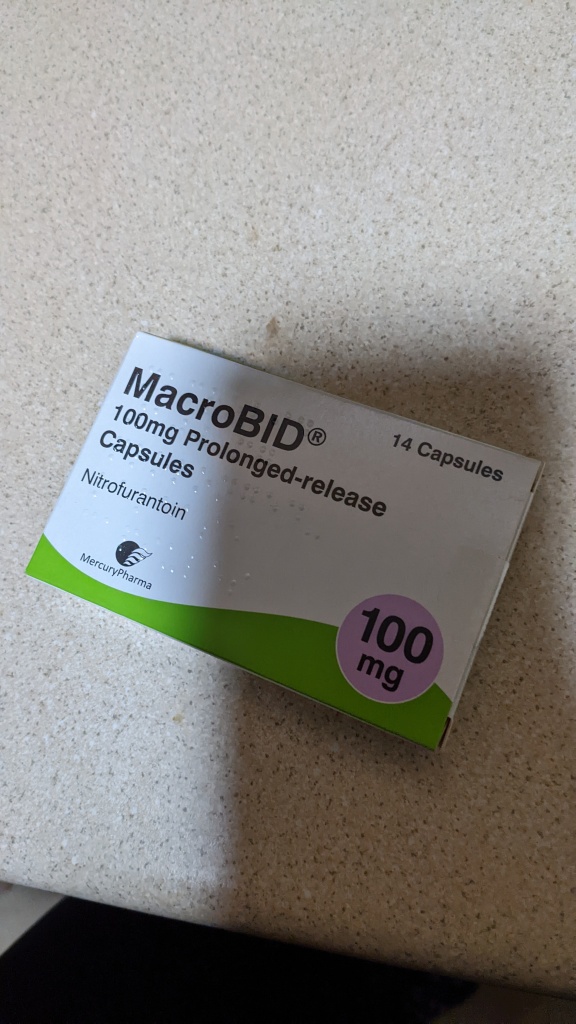
It’s something that I’m struggling with quite a lot at the moment, the sensation that my body is deteriorating at a rapid rate again. It goes through phases of this, its part and parcel of having multiple chronic conditions. Knowing that doesn’t make it any easier though. I recently made the decision to start having therapy again; struggling to accept new declines in my health is something I’m making sure to discuss.
My decline in health at the moment is mainly due to my Ehlers-Danlos, however my Dystonia is impacting this too. Ever tried using a catheter with hands that tremor? It’s by no means easy! I’ve not got a Botox date yet with the new hospital but I’m hoping they maybe willing to try injecting my hands so as to make this whole process a bit easier.
Urology Pick Me Up
Yesterday I attended my first appointment with my urology consultant. I had no idea what to expect. Urology issues are common in my family but I’ve never pushed to have my issues investigated. I had a scan once in 2012 and was told oh it’s just an overactive bladder just try to go to the loo less and you’ll be fine. I was training to be a midwife, I was queen of going to the loo less.
I hadn’t realised just how nervous I was. I’ve been coping with on/off incontinence issues for a longtime now, it can take me twenty minutes to void my bladder and it’s never fully empty. Throw in my prolapse on top and things are just not great in the pelvic region. When he asked me to explain what was wrong the words just tumbled out at top speed, I was vaguely aware of my hands nervously shaking. He stopped me a few times, got me to take a breath, reassured me there was no rush he had time to listen to me and that I could explain in as much detail as I could.
He was eccentric in his mannerisms, but put me completely at ease. After my neuro left this was the pick me up I needed. Before I left his clinic I had appointments in my hand to come back for further testing, instructions for at home testing and a date to review the results. The NHS at its finest.
Medication Success
As I have mentioned previously following a discussion with my neurologist I tried a couple of different medications to see if we could get a better handle on my spasms. In particular the spasms around my jaw as these cause me significant issues with pain, dislocations, and make it next to impossible some days to relocate my jaw; I’ve had the joy previously of coming round from an operation to have my jaw relocated under GA, only to dislocate when I wake up due to spasms, and have my surgeon coming running over to put it back in and bandage my jaw up. Not a pleasant experience.
Trihexyphenidyl is the medication we have added into my daily regime and it has made a huge difference. Little things like I can brush my teeth now with an adult sized toothbrush rather than a children’s one are possible, and instead of dislocating my jaw by brushing my teeth, my jaw is just in a small spasm and achy. My son commented the other day on the fact that my face isn’t wonky all the time and asked if my Jaw Dr had fixed my jaw. We had a quick chat about mummy’s silly brain and moved on, but for me that showed just how amazing this medicine has been.

I saw my neurologist the other week and he has suggested increasing the dosage further as I am currently not experiencing any side effects. I’m waiting to receive a copy of his letter to my gp explaining that I have the go ahead to do this at my own pace, so we can see just what improvements we can get.
Right now, thanks to lovely female hormones, I’m sitting here feeling quite sore all over as my body goes downhill each month due to the fluctuating hormonal changes. I’ve had several subluxes today in shoulder which have in turn aggravated neck spasms. Normally I’d be quite grumpy about all of this, and yes I’m not exactly thrilled, but having the Dystonia side of things more controlled doesn’t half make coping with the EDS etc, easier. Everything just feels that little bit more manageable right now, and that’s fantastic.
The Positive To Lockdown With Chronic Illness
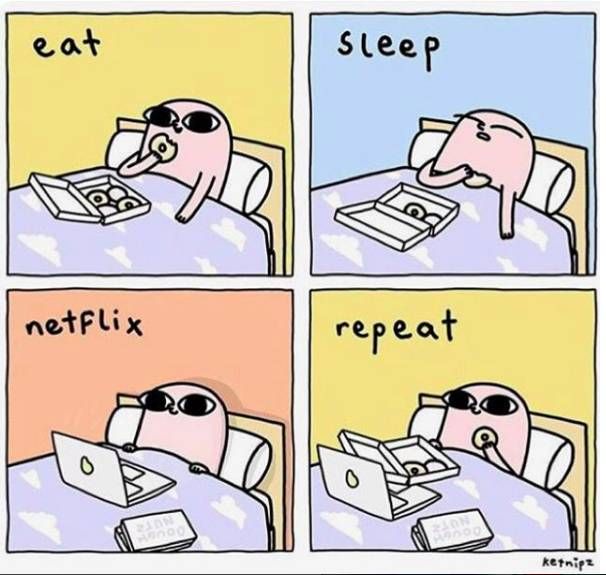
Whilst the multiple national lockdowns have come with there fair share of complications, for example cancelled treatments, the stay at home message has been a blessing in disguise for me. My body has been going through a decline/more frequent dislocations lately, which is less than an ideal. Now prepandemic I would have ignored my bodies pain signals, and ploughed through the day. A bad cycle, and habit that I had formed. Only collapsing in the evening, spoonless, in pain and annoyed at myself. Lockdown has relieved the social pressure to attended multiple groups a week, and be on the go all the time. For my particular lot of chronic illnesses it’s meant I have rested when I have needed to. I’ve had the opportunity to relearn my bodies distress signals.
Now don’t get me wrong, I’m not literally doing the above meme, though it has its appeals. But it has removed the guilt I felt on slow mornings when we watched a Disney film and had a slow start to the day, rather than rushing about. I still finish the day with no spoons. That is just life with chronic illnesses. However I rarely exhaust myself to the point that I have impacted the next day, which prelockdown was a frequent occurance.
Post-lockdown this is something I need to remember; that it is perfectly fine to acknowledge if my body is saying no not today. We can watch films, craft and bake in the house instead and have a lovely day. Just being kind to my body more often will allow more days out and in the long run that’s what works.

Disability & Discrimination During Covid-19
As the world adjust to Covid-19, those of us shielding in the UK (and the thousands of other impacted disabled folk) have read multiple news report to see how it will impact us next. Reading through each new regulation brought in to ‘flatten the curve’ screamed ableism. Whilst I agree the new rules were needed there was no consideration for the disabled people in society. Even under tier three regulations when we were allowed to reemerge from our homes after months of shielding, the regulations had no adaptions for us. They were discriminatory at best; put yourself in our shoes and suddenly being faced with having no access to a public disabled bathroom, having to que to shop with no where to sit when your physically need to, a lack of parking because many disabled spaces are now being taken up by outdoor seating for pubs and restaurants. Many disabled people who were being interviewed for research by Inclusion London reported that they felt excluded and marginalised.
There was a fantastic article in The Guardian today, with an interview by paralympian Sophie Carrigill addressing inequality, specifically around how the needs of disabled people have been ignored throughout our multiple lockdowns; you can read the article here. I completely agree with her, my social media is full of adverts every couple of scrolls trying to encourage me to sign up to one fitness program or another. Even my gym is going live and notifying me, along with influencers left, right and centre. Yet I am aware of only two people currently who cater with workouts for the disabled. What really shocked me though was when I went to comment under the article on facebook. It was disability discrimination and frankly simply disability hate comment after comment. The completely ignorance of people was astounding.
Adaptive Workouts – Disability FriEndly
A fellow Dystonia warrior Gina, runs Adaptive Martial Arts (I’m meant to be trying this when I’m having a healthy run myself!), which you can do via Zoom currently. The second, is a woman I recently found on instagram who teaches dance via her wheelchair her handle is @katestanforth .
Disability Discrimination – The evidence
There has been a significant rise in negative attitudes towards people with disabilities since the start of the pandemic, or to be more specific since the start of the shielding and need to wear a mask. Its not hard to find evidence of this, its all over social media but also sadly there multiple news and police reports on the subject.
A report by the neighbourhood watch found that a recent survey carried out found 62% of deaf and disabled people organisations reported an increase in disability hate crime referrals on the previous weeks – this was just after it was announced face masks were to become mandatory. I myself have twice been yelled at for not having mask on, once whilst relocating my jaw and once yesterday whilst having a sip of a drink.
The findings from Inclusion London Briefing are really quiet troubling about the rise in Disability Hate Crime during the course of this pandemic, you can read it here. To name a few examples 1) A rise in hate crime by neighbours including a rise in hate crime against disabled children whilst they are at home by neighbours. 2) A rise in verbal abuse against disabled peoples and instances of being spat at whilst out of the home due to inaccurate perception the disabled person being a ‘virus spreader’. 3) An in increase in online hate crime, often on social media platforms, in which disabled have been that their lives are inferior and that they are taking up resources from non disabled people.
Disability Inclusion Post Lockdown
Where do we go from here? It’s going to take a lot of work and advocacy to get us to some level of equality – which the Inclusion London Briefing article briefly does touch on. I don’t know when that will happen and how we go about getting the public to flip their perception again. Part of the way that perhaps that can happen is that when we come out lockdown the regulations allows for disabled people to use our bathrooms when necessary, and doesn’t turn our much coveted gold dust parking spots into garden seating for pubs. But that would only be the start, we need a whole lot more to turn peoples attitudes around.
Mental Health: It’s About Surviving Not Thriving
The current times we are living in are unique. Nothing we have ever lived through before could have prepared us for a pandemic requiring multiple lockdowns and restricted social interactions. Reports on rising rates of depression, anxiety and mental health issues are really not surprising. There is no normal currently. Life has become about surviving not thriving through each moment, and focusing on the little wins as they come. If you wore actual clothes instead of fresh PJS today then in my eyes you are smashing Lockdown Three.
If you are struggling right now and feel like you need a bit of help please do explore the options below. I myself have tried several of them and am more than happy to discuss this if needs be. Simply send me a message via the Dystonia and Me facebook page and I will get back to you as soon as I see it.
NHS resources for Mental Health Help
This link will take you to the NHS Every Mind Matters page. Take the time to really explore this site as it is full of information. If you are finding it hard to absorb maybe bookmark the page or print off some bits and come back to it. One of the great aspects of this site is that it has a feature called Your Mind Plan Quiz; you answer 5 questions and it creates a plan designed to improve and maintain your Mental Health.
2) https://www.nhs.uk/conditions/stress-anxiety-depression/moodzone-mental-wellbeing-audio-guides/
If audio guides are more your cup of tea then these free NHS audio guides may do the trick, there are multiple ones to choose from depending on what aspect on your mental health you are struggling with.
A-Z Mental Health Charities Link
https://www.nhs.uk/conditions/stress-anxiety-depression/mental-health-helplines/
Whether you need help yourself, or you concerned about a loved one, these charities and support groups will be able to help or point you in the right direction.
Urgent NHS Mental Health Helpline (England Only)
https://www.nhs.uk/service-search/mental-health/find-an-urgent-mental-health-helpline
This 24 hour helpline is available for people of all ages. The link will take you straight to the assessment which will get you started.
Improving Routine To Improve Pain Levels
Health conditions can have both a physical and emotional toll, for example chronic pain; this can impact your sleep, cause more fatigue and leaves you starting the day just as drained as when you went to bed. A routine can change all that.
Now I’m not suggesting you plan out every moment of your day!
However a well thought through routine can empower your day, lowering your pain levels over all as you’ve optimised the way you have used your body.
It’s worth asking yourself when is your pain worse in the day? What activities does that impact? Make a list. From here you can proactively look at your routine and adjust how you manage your day which in turn should lower your pain levels. An example of this is if you struggle more in the mornings, then lay out what you need (or ask someone to help you) in an accessible place. This will save you time and energy in the morning.
Make sure to include time for you in your routine and space out energy consuming tasks over the day. If there is a task you are particular struggling with think about how it can be altered. For example, when chopping vegetables does sitting on a stool help? Would buying pre-chopped vegetables be a more realistic option? Is there someone else who could do this task for you?
Doing to much will result in a Boom and Bust cycle. Pacing is your friend.
I’ll be live tomorrow night with more on the Boom Bust Cycle.
Let’s Bin Perfection.
What is perfection? It’s a word that we toss around like it weighs not a thing, when the reality is that’s a ball and chain dragging our mental health through the mud chasing after. I’m sure my own view of perfection is mighty different to yours! If it wasn’t then it would be a case of bottling up a potion or creating a word doc telling you what steps to follow to achieve perfection and selling it for a killing; I’d be able to have my own purpose built bungalow. No it’s different to all of us yet we all seek it.

It’s the little negative moments experienced that make us seek it. It’s the old man tutting and shaking his head repededly at me because he couldn’t push past my wheelchair easily. It’s the side eye and the sarcastic comments that are made by people who don’t understand ambulatory wheelchair users exist. It’s dislocating 15 times in one day and just having enough. It’s all these things and so much more that make us want to chase perfection.
The fog of insecurity in our brains full of thoughts like if I just weighed less, if I wasn’t chronically ill, if I wasn’t in my chair, if I was more like them; it’s all based on the negative moments and turned into insecurity and self doubt. It’s a weight that no one needs.
But chasing perfection is futile. It’s an unachievable concept. It’s time we move away from it. On that note can we bin chasing normal as well? Learn to love ourselves the way we are. Life would be boring if we were all the same. I know I would rather be my unique self than identical to every other person.
 Dystonia and Me