Posted in Archive, May 2015

Dystonia Awareness Week 2015 – The Road To Diagnosis

It’s Dystonia Awareness Week 2015! In a similar way to last year I plan to do a series of blogs explaining the different aspects of Dystonia. Normally my family and I hold a bakesale to help raise funds for The Dystonia Society during the awareness week. However due to the majority of my family having exams this month we have decided to delay this until June. I’ll be posting the date for this soon.

I want to focus today on the road to diagnosis and treatment. This is such a scrambled and boggy area to tread. Many people with Dystonia suffer with the condition for years before getting diagnosed. Often we are made to feel as if it is all in our heads, and end up with referrals for counselling. Trying to get medical professionals to listen and take us seriously can be extremely hard, especially if they have not had any experience with the condition before. I don’t believe they intend to make us doubt our own sanity but it happens.

In 2012, for example, I spent just over a week in a local hospital after the muscles behind my eyes spasmed, forcing my eyes to roll back in the socket and stay there, leaving me functionally blind for 15 hours. Those 15 hours were hideous, I was terrified and in a fair amount of pain. When you looked at me only the whites of my eyes could be seen. I was repeatedly told by doctors during this time to “just roll your eyes down”. Needless to say it became hard not to snap and inform them that if I could do that, I would have done so already. I felt as if no doctor believed me. I was forced to talk to a psychiatrist during my stay.

A couple of months after this I met my wonderful neurologist, who took the time to really listen and examine my symptoms. I was fortunate to get diagnosed in a matter of months. Many others with the condition are misdiagnosed for years, decades in some cases! This is one of the many reasons awareness of this debilitating and life changing condition is necessary. A correct diagnosis leads to treatment that can help improve quality of life. The more awareness that there is the better chance of sufferers being diagnosed in a far more timely manner.

On Wednesday 6th May a Dystonia Awareness message will be sent out Via Thunderclap. The more people that sign up for this the further the reach of the message. So please sign up at the following link https://www.thunderclap.it/projects/24206-dystonia-awareness-week-2015 .
Posted in Archive, May 2014

Dress for Dystonia

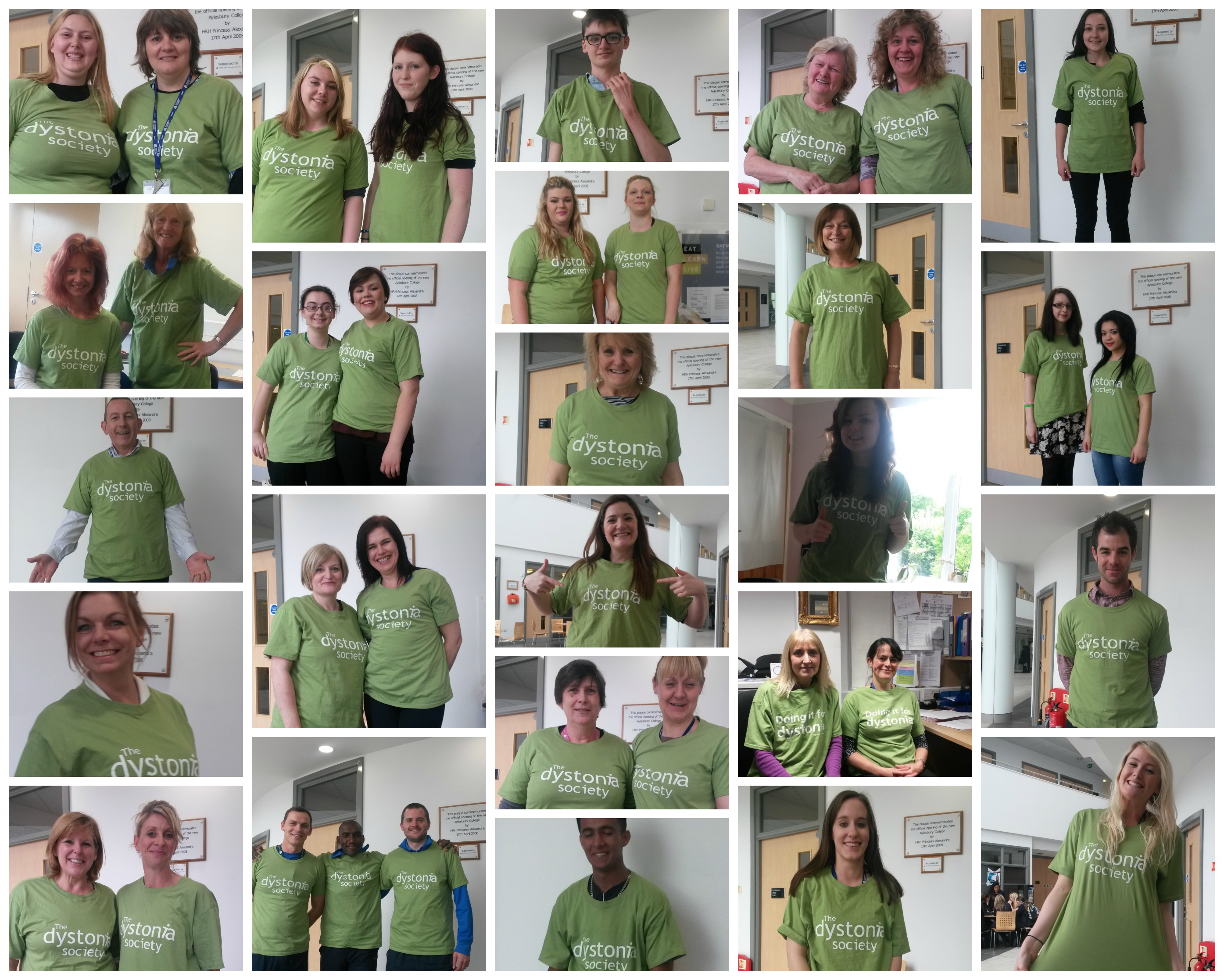
As I mentioned the other day I did some fundraising and campaigning at my college this week to raise awareness of Dystonia. On the Dystonia Society’s website they have a list of fundraising ideas one of them being Dress for Dystonia. This title inspired me. I encouraged both students and staff members of the college to get involved with my awareness raising campaign by putting on a Dystonia Society top. This ticked off two awareness ideas at once as the tops are green and it was twist on the Dress for Dystonia idea. Everyone who put on a top posed for a photo which I put into an awareness photo collage. Lots more people were willing to get involved than I expected which was great! The college have even done a news article on it and put it up on their website which is amazing as this too provides more awareness of Dystonia. Image

Posted in Archive, May 2014

Raising Awareness

Raising awareness of Dystonia is vital. The Dystonia Society’s website says that an estimated 70,000 people in the United Kingdom have the condition. Considering just how many people this is, it is still such an unknown condition to both the public and the medical society. By raising awareness and funds more research can be done. Dystonia may not be life ending but it is life limiting. Without research there is no improvement in treatments for the condition and there is no cure.

When I became ill with the condition I had never heard of it, I had lived my life blissfully ignorant. Now it’s fast approaching the two-year mark of my being ill. Dystonia may have taken away many things from me but it has also inspired me. The only way change will happen is if we bring it around. We can sit and moan about Doctors not understanding the condition all we like, but what difference will that make? By actually having the condition and experiencing it we can choose to empower ourselves with knowledge and spread awareness.

I spent yesterday sat in my College canteen raising money and awareness for Dystonia. The age range of students at the college is from 16 to mature, yet all no matter how old or young were prepared to listen to what I had to say and asked lots of questions. I went with lots of leaflets that The Dystonia Society had provided me with and every single one of them got taken by people wanting to go away and read more.

Awareness is key to a cure being found and weeks like this one are the perfect time to do it. Tea parties, joining in with campaigns like the Go Green for Dystonia  one or getting involved with Thunderclap, are all so easy but so effective!! Dystonia Awareness Week is not over until the 11th May, so if you’ve not joined in yet, why not now, every voice counts! https://www.thunderclap.it/projects/9777-dystonia-awareness-week

Posted in Archive, May 2014

Blepharospasm

Blepharospasm is a type of Dystonia that affects the eyes. These spasms are often rather painful and can involve the eyelids as well as the muscles behind and around the eyes. As with all types of Dystonia people experience different types of spasms, some people have increased sensitivity to light and rapid blinking, whilst others find their eyes spasm shut, and in some cases the muscles behind the eyes pull the eyes up into the head making the person functionally blind. I experience several of these spasms and find that the sensitivity to light often triggers the other spasms.

Generally speaking symptoms usually appear in people around the ages of 50 to 70. However it does affect younger people, Blepharospasm can appear on its own or in conjunction with or part of other Dystonias such as Meige Syndrome or Generalized Dystonia. Blepharospasm is thought to affect around 7,000 adults in the UK.

There is currently no known cure for Dystonia. Treatment for Blepharospasm normally involves regular Botox injections. I find that six weekly injections around my eyes helps with symptoms such as spasming shut and rapid blinking, but the muscles behind the eyes cannot be injected. By wearing dark sunglasses in the sunlight or in brightly lit area, I can reduce the chances of going blind but it still happens. The longest this has ever happened for is 15 hours. Some people find that pressure points around the temples, and nose area can help relieve the spasms. Obviously these pressure points differ from person to person.

In the picture below you can see my eyes pulled back in a spasm leaving me functionally blind.

as

The Dystonia Society’s website has some great tips on how to cope with the condition so head on over to it to find out more http://www.dystonia.org.uk/index.php/about-dystonia/types-of-dystonia/eye-dystonia-

Posted in Archive, May 2014

Dystonia Awareness Week

From today to the 11th of May is Dystonia Awareness week! To celebrate it and help spread awareness I have taken apart in the Go Green for Dystonia campaign. I decided that I would do this in a similar way to last year and have dyed a section of my hair green for the week (luckily it will wash out quickly).

Photo: Green streak in my hair and wearing green for Dystonia awarness week.

I have a of couple awareness activities planned for this week besides being part of the Go Green for Dystonia Campaign. The first of my awareness activities is to do a blog every day, minus today’s entry I plan for each one to focus on a different aspect of Dystonia and how they can impact on day-to-day life. On Wednesday I am running an Awareness event at my college which I am really excited about, it’ll be a fantastic opportunity to educate lots of people on the condition and raise a bit of money for The Dystonia Society.

I have also signed up to Thunderclap, which is something all of you lovely readers can get involved with too! Thunderclap sends out an awareness message via your Facebook/twitter/tumbler (depending on what you choose) at 1:30pm on May 9th. It’s a great way to spread the word about Dystonia. Even Stephen Fry has signed up for it! If you would like to join in here is the link https://www.thunderclap.it/projects/9777-dystonia-awareness-week.