Posted in Archive, May 2016

What Causes Dystonia?

Currently the exact cause of Dystonia is not known; though a number of problem areas have been linked to the condition. Research has shown that there is a fault with a section of the brain called the basal ganglia. It is only in a small minority of sufferers that the condition has a clear cut cause.

Dystonia can appear on its own, secondary to another medical issue or as a result of medication – this is known as Tardive Dyskinesia. At the current time 80% of children diagnosed with Dystonia have it alongside a primary condition for example Cerebral Palsy. In adults the condition can be caused by a stroke and other neurological issues.

As research is progressing more genes are being found to be related to different forms of the condition. Studies have found that some cases of Generalised Dystonia are hereditary. However even if there is a genetic issue it does not guarantee that you will pass on the condition. It is thought that there is between a thirty to fifty percent chance of a child inheriting Dystonia depending on the mutated gene and type of Dystonia. So far over 20 genes have been identified in relation to Dystonia, with more being found all the time.

For more information on the genetic links to Dystonia I recommend http://www.dystonia.org.uk/index.php/about-dystonia/causes/is-dystonia-inherited

Posted in April 2016, Archive

Vulnerability and Dystonia

Living with a chronic condition can have a detrimental effect on the sufferers attitudes or mental health. Many people experience disbelief from both the public and medical professionals during their fight to achieve an accurate diagnosis. Due to this many choose to refrain from openly talking about mental health conditions and passed traumas with doctors and those close to them. Often this becomes an early defensive behavior that is learned in on order to prevent pre-emptive judgement.

In 2012 during my fight for a diagnosis I found myself in the John Radcliffe for 8 days as I had developed Pain Triggered Non Epileptic Seizures, and my Dystonia had spread from my jaw to my eyes. I was very honest about my past with the consultants in charge of my care. I expressed that I had suffered physical abuse during my teenage years, that I had sought help and that I was now in a much happier place. I still view being honest with the doctor in charge of my care as a mistake however, due to the fact I had had this unfortunate experience I was informed all my symptoms were psychosomatic, and that I need neuro-psychiatric contact. As I’m sure you can imagine I did not take this well. I remember clearly stating that I would go talk to their psychiatrist, purely so I could jump through their hoops and prove them wrong.

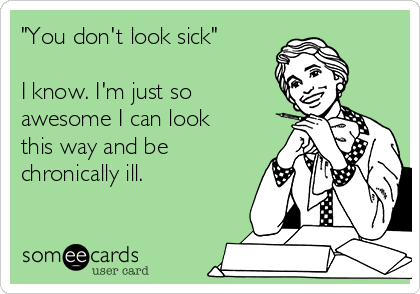
Mere months later I had my diagnosis of Dystonia and a letter from my neurologist stating that my past experiences had no impact on my current state of health. That letter has not stopped doctors and acquaintances questioning me over the years though. On numerous occasions I have been asked if I am depressed. I am generally an optimistic person who loves nothing more than to laugh. Yet being repeatedly questioned has its impact. I am defensive of my health, I feel like I have to justify myself and that leaves me feeling vulnerable. For if people struggle to believe me when they can see the physical symptoms in front of them, what else will they close their mind too? Vulnerability is an emotion that too many sufferers of chronic illness experience. It comes in both physical and emotional forms. One of the best things a person can hear is ‘I believe you’. It is an empowering statement that allows us to relax and breath. Acceptance free of doubt opens up a line of honest communication. Something that we all need.

you-dont-look-sick-awesome.png

Posted in April 2016, Archive

So What Is Dystonia?

In the United Kingdom it is estimated that at least 70,000 people suffer from Dystonia. Despite being the 3rd most common neurological movement disorder many people have never heard of it. The word Dystonia describes uncontrollable muscle spasms which are caused by the brain firing incorrect signals to the muscles. There are many types of Dystonia however, and no two types present exactly the same. The incorrect signals can cause the body to take on abnormal postures, tremor, contort and more. Many GPs will not see the condition during their practising career which can make knowing when to refer for a diagnosis difficult. Many sufferers go years before diagnosis occurs.

The condition is incurable and a tricky one to treat. Whilst many people manage to live full lives with appropriate treatment, this fact does not lessen the impact of the condition. A task you may be capable of preforming one day you may be unable to perform the next. If the condition appears in adulthood, in the majority of cases, it will remain contained to this area – this is known as focal Dystonia. However typically if the condition appears during childhood it generally will spread across numerous parts of the body -Generalized Dystonia.

Obtaining a diagnosis and receiving treatment can make a huge difference to a person’s quality of life. Without treatment I would be unable to see consistently, I would struggle to communicate due to jaw spasms, my head would be lopsided and my arm would be uncontrollable. Due to lack of awareness reaching the necessary professionals diagnose can be difficult, which is why awareness week is so important; increased awareness will not only help improve diagnosis times but can lead to more funding to find a cure.

Are you doing anything for Awareness Week? If so get in touch and let me know.

13120414_890520791073701_1045528161_o (1)
Green for Awareness Week
Posted in April 2016, Archive

Hospital Post

Receiving post is a very everyday aspect of life. Normally it’s not something that I would get over excited about. Every now and then though there is an exception. I received today three different types of support splints that the hospital had decided to order for me. The team I was under in the hospital witnessed several of my dislocations and noticed general issues in my hands and feet that could be improved with ease.

Three of the four splints arrived this afternoon. Two are designed for my wrists and thumbs. Part of the issue with EDS is that the brain does not always know exactly where the joints are. These splints help provide feedback to the brain along with stabilizing the joints.

The third splint is a gel ankle brace. If there was an Olympic medal for ankles giving away and falling over, I would take the gold every single time. My ability to fall down curbs, over thin air, and up the stairs is impeccable. The gel supports on both sides of this will cushion the joint whilst aiding stabilization. My skin breaks very easily due to the EDS so this design should work wonderfully with my skin.

13073133_888100227982424_923992250_o


I am hoping that the splints as a way of treating the EDS, and my upcoming Botox injections, should mean I spend less time hugging the floor.

Posted in April 2016, Archive

Curve Ball

You would think after almost four years I would have fallen into sync with the pattern of my botox cycle. I would know when to expect the good spells, and be prepared for the out of control moments. Perhaps it’s simply misguided denial that has resulted in me still being unable to predict these moments, it wouldn’t surprise me really.

Up until this evening  I had been enjoying a really good run. My body had been on very good behavior and as usual when I’m in this part of the cycle I had been making the most of every blissful pain free second. This evenings turn hit me out of the blue. I had been feeling slightly off whilst getting ready for a night out with my friends but hadn’t been able to quiet put my finger on why, so had decided to just ignore it and carry on laughing.

It wasn’t until we started making our way to our first destination of the evening that I realized what was wrong. Sitting down I had not noticed that the top of my back was slowly contorting. Each step I took was agonizing. My body simply twisted and further muscles joined in.

I’m not a naturally quiet person, I only generally quieten down when I’m in pain. The fact that I was virtually silent alerted my friends quickly that I needed to go home. So here I am now, lying down, arguing with myself, dressed up for a night out.

But hey at least I recognized I needed to come home.

Posted in April 2016, Archive

Chip; Dating Disaster 4

After a productive three weeks in the hospital I’m finally back and settled in to university life again. What a better way to celebrate than providing you with the next installment of dating disasters? So hold on to your screens, grab some popcorn and settle in for a dose of embarrassment and reality.

I’d been seeing a guy, let’s call him John Smith, for a couple of weeks. He was entertaining, the attraction was mutual and things between us were progressing well. We had reached that thrilling stage of where do we go from here? It’s always an entertaining dance of social blunders. It’s an attractive situation to be in, and we were both thriving off the tension building. We had talked briefly about my jackpot of disorders and at the time I think he truly believed that he could cope with it all. I was more than happy to believe this. You would think I would know better by now. It would have been different if he had seen just what contortionist tricks my body is capable of from the word go, but when we met my injections were in full swing and so he had never borne witness to my reality.

One night, not that long ago, we were curled up watching a comedy. I always laugh hard at the sound of my own laughter, I’m a bit of a nutter like that. Seeing me in stitches conjured up warm and fuzzy feelings for Mr. Smith, and he leant over to kiss me. It started off great, slow, full of nerves from both of us. Have you ever yawned whilst kissing someone? Not the most attractive move, so to try and hide this, I pulled back. No one wants their face yawned on after all. John read this as me giving into my nervousness, so a little bit too enthusiastically placed his hands on either side of my face to pull me back towards him. If he had had his eyes open, he would have seen the horror in mine. As he pulled on my yawning cheeks I felt the spasm roar to life in my jaw, and the oh so familiar pain as my jaw dislocated.

Everybody deals with witnessing a person dislocate differently. Some people feel sick, others just want to get you seen by a Doctor. I can understand all of these reactions, I’m certain if it was the other way around I would be exactly the same. What I didn’t expect was the wide tumbling range of emotions that erupted from him. For the most part he was repulsed, partially due to the dislocation and partly because he had caused it. Then came the upset, anger and panic. I sat there rubbing in the volterol, knocking back muscle relaxants and pain killers, alternating between trying to calm him down and relocate my jaw.

It was one of the first times I have had someone blame me for being too breakable. At the time I was hurt, it wasn’t like I had not forewarned him. Now I hold my hands up and laugh it off. I am the opposite of breakable, I’m much like Chip the teacup in Disney’s Beauty and the Beast; Slightly chipped but otherwise a barrel of laughter, and perfectly functioning. Looking at me on a bad day I can understand why a person may get the wrong impression, but sit calmly and talk to me and I’ll tell you just how resilient I am. Stick around and I’ll even show you. For now, I’m going to enjoy being ‘breakable’, laugh at my mistakes, highs and downright weird life path. I love my body, flaws and all.

Posted in Archive, March 2016

3 Weeks Rehabilition Program

After a year and a half of waiting tomorrow I am being admitted into The Royal National  Orthopedic Hospital Stanmore for intensive rehabilitation for my Ehlers Danlos Syndrome Type Three. I am a mix bag of nervous and excitement. From talking to previous inpatients  of the program it sounds extremely positive and successful. There are many different components to the rehab, such as hydrotherapy, physiotherapy, pain management and sessions with psychologists. On the most part I am very optimistic, my consultants all feel that the treatment should offer significant improvement.

The only part of the program I am wary about is the psychology sessions. If I could opt out of these I would.  Now I shall be sensible and fully cooperate with them but I can’t help my reluctance. I have had years of sessions with varying types of psychologists. Since I have been ill I have had specific sessions with cognitive behavioral therapists to attempt to control my seizures, however out of the three therapists I have seen only one has looked at me holistically. Due to this my file now contains a note from my neurologist instructing therapists not to focus on my past and informing them it has no impact on my medical situation. Click on  VLOG and blog for more info. However, many therapists choose to ignore this. Whilst I am sure the psychologists I am going to be seeing over the next few weeks will be lovely, I worry that they will be like the many I have seen before.

I get admitted at 8:30am tomorrow morning, so it’s not long to go now. My neurologist is convinced it will make a huge difference to my jaw and I’m keeping my fingers crossed he is right.

Posted in Archive, March 2016

Date & Sex Debate…

One of my favorite comments on social media recently stated that they loved my recent blog post but when would I be posting another dating failure as they tickled her. Well here you go! Indulge and delight in my rather hideous taste in men.

This happened before Christmas and there are so many aspects of this date which were hideously embarrassing. This is one of the few dates that I have cut short, after simply losing my patience. It was a first date in the middle of the afternoon over coffee. After twitching and rather violently hitting the wall behind me I felt like I should explain slightly further my left arms unpredictability. “So like, if you twitched and hit me during sex, does that mean I get to spank you?” What should have been a two-minute discussion before returning back to normal pleasantries resulted in a passionate, at least on my side, debate on why it was not okay to ‘punish’ me for twitching.

Now I have no issue with people being into kinky bits and bobs in the bedroom, if that’s what you like then go for it. However, don’t you dare ever suggest that you should be allowed to ‘punish’ me for something that is completely beyond my control. I’m quite used to people bringing sex up on dates, normally they just want reassurance that I’m not going to turn around and say I cannot possibly do that. Which is fine, I am more than happy to have an open and frank discussion about it. What I cannot wrap my head around is that on a first date someone is willing to debate in a coffee shop the fact that I’m saying no you may not sexually punish me for being ill.

As you can imagine I made my excuses and left not long after it became apparent that he couldn’t see my view point.

Posted in Archive, March 2016

Salute to Benedict The Alien

It’s Brain Awareness Week! Whilst I could whittle on to you about the many theories of how exactly the brain develops Dystonia, I figured I would just link you to The Dystonia Society instead as they have explained it in a far more efficient manner than I ever could. The Basal Ganglia theory aside, come Dystonia awareness week I’ll go into that some more. http://dystonia.org.uk/index.php/about-dystonia/dystonia-and-the-basal-ganglia.
Today I want to talk about my brain. Not brains in general, mine.

We are all unique individuals. A huge part of our individuality is our brains: they control our thoughts, motor process, emotions, impulses and so much more. They are the reason we have moments that leave us feeling like the next Shakespeare, and the reason we wake up some days look at our messages and question where on earth our sanity went the night before. After my diagnosis I loathed my brain with a passion that would make Hades quake in his fiery little boots. I was no longer ‘me’. I had new quirks that in all my nineteen years I had never met. I did not know how to love them, laugh at them, let alone tolerate them. Gritting my teeth and swearing out of my mum’s earshot was the best I could do for a rather a long time. It may not seem like the right attitude to have, but it’s what worked for me. I blamed my brain for why my life, which had been darn great up until that point, was crumbling around me. You could superglue me up as much you like, but there was no way the pieces were going to fit back in the same places.

These crumbled bits made a new jigsaw, and what do you know, four years on I have learnt to love my new quirks, love my brain and love every crazy aspect of my life again. My little alien has added another element to it, I’ll admit I still swear at it on a frequent basis, but I laugh far more than I did before. I am surrounded by positive people and I have barrels full of confidence that were worlds away when this little alien took hold and started to disrupt the signals bouncing around my brain. I’m always going to long to be ‘normal’, but I no longer view Dystonia as the alien that ruined my life. It’s now simply an uninvited house guest who is happy to provide entertainment for all.Invisible Illness, Chronic Pain, Chronic Illness, Lupus Awareness, Fibromyalgia, Endometriosis, POTS, Hypermobility, Quotes, Chronic Migraine, Chronically Awesome, Chronically Fabulous, Spoonies, Lupies, Lupus Warrior, Fibro Fighter, Epilepsy, Brain Aneurysm, Spoons:

Posted in Archive, March 2016

I’m Not Sorry…

My blog post earlier in the week sparked conversation on social media which is something I love to see; it also got me thinking. When I inform a date/potential date that I’m ill, I almost always apologise. I don’t quite know why I say sorry. Perhaps it is because I know that I’m not exactly what you see, but who really is, or maybe it is an automatic reaction to help deal with the social awkwardness that I’m feeling and attempting to suppress. I am awful for stuttering out an apology whenever nerves take hold.

This is a quality of myself that I can control. A rather refreshing thought. So after a period of reflection I’ve decided I’m no longer going to apologise for my conditions. They are part of me, good and bad. If I can learn to see the humour in them, then others can too. That’s not to say I won’t profusely apologise if I spasm and hit someone, of course I will – then again I’ll also probably laugh.

I feel quite delighted with my decision. Taking another step, and embracing my alien just that bit more.